

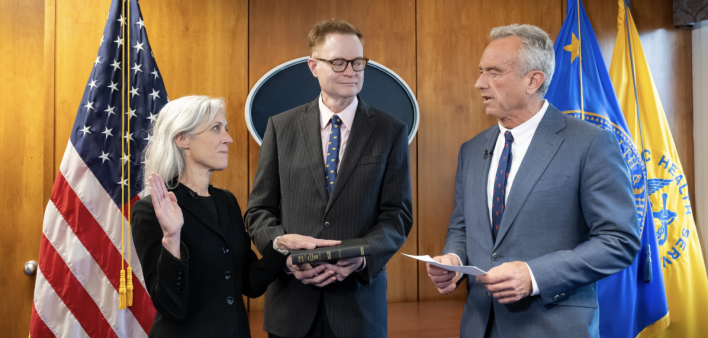
Susan Monarez, PhD, is out as director of the Centers for Disease Control and Prevention (CDC) after friction with Department of Health and Human Services (HHS) head Robert F. Kennedy Jr. At least three high-level agency officials resigned in protest, including Demetre Daskalakis, MD, MPH, who previously led the nation’s HIV prevention efforts and mpox response.
The a post on the X (Twitter) social media site, HHS announced Wednesday evening that Monarez “is no longer director” of the nation’s premier public health agency. Named acting director in January, Monarez was sworn in to the top post on July 31, just a week before a shooting at the CDC’s headquarters in Atlanta left a police officer dead and staffers traumatized.
Susan Monarez is no longer director of the Centers for Disease Control and Prevention. We thank her for her dedicated service to the American people. @SecKennedy has full confidence in his team at @CDCgov who will continue to be vigilant in protecting Americans against infectious…
— HHS.gov (@HHSGov) August 27, 2025
Soon after the HHS announcement, Monarez’s attorneys, Mark Zaid and Abbe Lowell, took to social media to say that she had not yet resigned or been fired, accusing Kennedy of “weaponizing public health for political gain.”
“When CDC Director Susan Monarez refused to rubber-stamp unscientific, reckless directives and fire dedicated health experts, she chose protecting the public over serving a political agenda. For that, she has been targeted,” they wrote. “Dr. Monarez has neither resigned nor received notification from the White House that she has been fired, and as a person of integrity and devoted to science, she will not resign.”
Abbe Lowell and I represent CDC Director #SusanMonarez. Contrary to govt statements, Dr. Monarez has neither resigned nor yet been fired. She will not resign. We have issued the following statement:
— Mark Zaid, Esq (@markzaidesq.bsky.social) August 27, 2025 at 4:15 PM
[image or embed]
The attorneys argued that as a presidential appointee and the first CDC director to be confirmed by the Senate, only the president could fire Monarez. But later that night, the White House confirmed that she has indeed been terminated, The Washington Post reported.
“As her attorney’s statement makes abundantly clear, Susan Monarez is not aligned with the President’s agenda of Making America Healthy Again,” White House spokesman Kush Desai stated in an email.
Citing anonymous agency sources, news reports suggested that Monarez has increasingly clashed with Kennedy, especially around vaccine policy. While she affirmed her support for vaccines during her June Senate confirmation hearing, she has not publicly criticized the HHS head.
A longtime vaccine skeptic, Kennedy launched a study in March to examine the purported link between vaccines and autism, a hypothesis discredited by extensive prior research. In June, he removed all 17 members of the CDC’s Advisory Committee on Immunization Practices, which makes national vaccine recommendations, replacing them with ideological allies.
In May, Kennedy announced that COVID-19 vaccines would no longer be recommended for healthy children or pregnant women. Earlier yesterday, the Food and Drug Administration approved updated COVID boosters from Moderna, Pfizer and Novavax, but only for people over age 65 and those with risk factors for severe illness.
[Update: On Thursday, the White House tapped Health and Human Services deputy secretary Jim O’Neill, Kennedy’s right-hand man, as interim CDC director, The Washington Post reported. O’Neill, a Silicon Valley investor, previously served as an HHS deputy secretary during the George W. Bush administration. White House press secretary Karoline Leavitt said the administration would soon announce a permanent replacement for Monarez.]
Other CDC Leaders Resign
Monarez’s ouster prompted the resignation of agency leaders including Daskalakis, CDC chief medical officer Debra Houry, MD, MPH, and Daniel Jernigan, MD, MPH, director of the National Center for Emerging and Zoonotic Infectious Diseases. Jennifer Layden, MD, PhD, head of the CDC’s Office of Public Health Data, Surveillance and Technology, will also leave the agency, Politco reported.
“For the good of the nation and the world, the science at CDC should never be censored or subject to political pauses or interpretations,” Houry wrote in a letter to colleagues obtained by Inside Medicine. “I am committed to protecting the public’s health, but the ongoing changes prevent me from continuing in my job as a leader of the agency. This is a heartbreaking decision that I make with a heavy heart.”
[Update: On Thursday, CDC staffers staged a walk-out at the CDC offices in Atlanta, where Daskalakis, Jernigan and Houry addressed the crowd.]
Of the four resignees, Daskalakis is best known in the HIV world. Most recently director of the CDC’s National Center for Immunization and Respiratory Diseases, he was previously deputy commissioner for the Division of Disease Control at the New York City Department of Health and Mental Hygiene and director of the Division of HIV/AIDS Prevention at the CDC’s National Center for HIV/AIDS, Viral Hepatitis, STD, and TB Prevention. A gay leatherman, Daskalakis is widely acclaimed for his intimate knowledge of and connection to the communities he serves. (He was voted Best Celebrity Advocate for the 2022 POZ Awards.) In 2022, he was tapped to co-lead the national response to the burgeoning mpox (formerly monkeypox) outbreak.
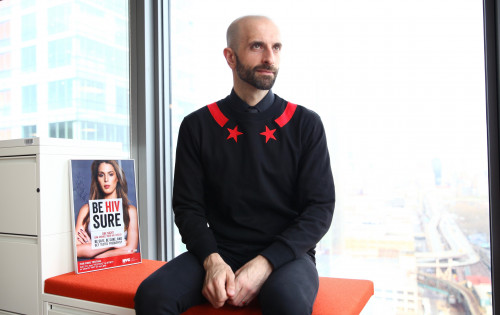
Demetre Daskalakis, MD, MPH, New York City’s assistant commissioner of the Bureau of HIV/AIDS Prevention and Control at his officeBenjamin Ryan
Daskalakis penned a blistering resignation letter, which he shared on X.
My resignation letter from CDC.
— DrDemetre (@dr_demetre) August 27, 2025
Dear Dr. Houry,
I am writing to formally resign from my position as Director of the National Center for Immunization and Respiratory Diseases at the Centers for Disease Control and Prevention (CDC), effective August 28, 2025, close of business.…
“I am unable to serve in an environment that treats CDC as a tool to generate policies and materials that do not reflect scientific reality and are designed to hurt rather than to improve the public’s health,” he wrote. “Having worked in local and national public health for years, I have never experienced such radical non-transparency, nor have I seen such unskilled manipulation of data to achieve a political end rather than the good of the American people.”
“For decades, I have been a trusted voice for the LGBTQ community when it comes to critical health topics. I must also cite the recklessness of the administration in their efforts to erase transgender populations, cease critical domestic and international HIV programming and terminate key research to support equity as part of my decision,” he continued. “Public health is not merely about the health of the individual, but it is about the health of the community, the nation, the world. The nation’s health security is at risk and is in the hands of people focusing on ideological self-interest.”
Public health leaders, clinicians and advocates expressed dismay over the CDC departures and fears about the agency’s future.
“Frankly, the very future of the CDC is unknown,” wrote MedPage Today editor-in-chief and Inside Medicine author Jeremy Faust, MD. “Thousands of good scientists and other agency officials remain. But without these key leaders—non-partisan career officials widely respected both internally and beyond—the agency is genuinely at risk of losing its ability to carry out its core mission.”
“The mass resignations of CDC expert leaders present a clear and present danger to Americans of all ages and leave our nation extremely vulnerable to a wide range of public health threats from outbreaks to bioterror attacks,” Infectious Diseases Society of America president Tina Tan, MD, said in a statement. “This loss of highly experienced CDC leadership is the latest devastating result of the administration’s sustained attacks on public health, and it absolutely must be the last. It is time for fundamental changes and a return to evidence-based policy. The administration’s current trajectory for destroying the public health system is reckless and cannot continue.”



Comments
Comments