

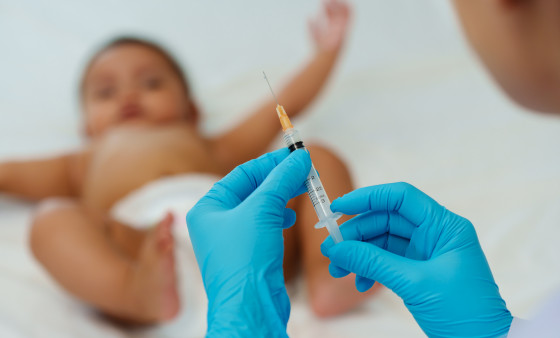
[Update: On December 16, acting CDC director Jim O’Neill formally adopted ACIP’s proposal to stop recommending the birth dose of the hepatitis B vaccine for all infants. However, the CDC did not endorse the committee’s recommendation to check antibody levels to determine whether children need additional vaccine doses.]
This report was originally published on December 6, 2025.
A Centers for Disease Control and Prevention (CDC) vaccine advisory committee, recently reconstituted by Health Secretary Robert F. Kennedy, Jr., wants to stop recommending a birth dose of the hepatitis B vaccine for all infants, raising fears of an increase in cirrhosis and liver cancer.
“The hepatitis B vaccine birth dose has proven to be among our most effective tools for protecting infants from a preventable, cancer-causing disease,” the Hepatitis B Foundation said in a statement. “The committee members dismissed the extensive body of scientific data and real-life experience that prove the necessity, safety and value of the universal birth dose vaccine for hepatitis B.”
During a two-day meeting on December 14 and 15, the Advisory Committee on Immunization Practices (ACIP) voted 8-to-3 to no longer recommend that all infants should receive their first dose of the vaccine immediately after birth, instead recommending it only for babies whose mothers test positive for hepatitis B virus (HBV) or whose status is unknown. Mothers who test HBV negative are advised to consult their doctors and make an individual decision.
For infants who do not receive the birth dose, ACIP said the initial dose should be administered no earlier than two months of age. The panel also voted 6-to-4 that children should be tested for HBV antibodies to determine whether they need further doses. The CDC previously recommended that all infants should receive the first dose of the vaccine within 12 to 24 hours after birth, followed by two more doses at age 1 to 2 months and at 6 to 18 months.
ACIP develops national recommendations for vaccines for children and adults, which are typically approved by the CDC director—a position that remains vacant after the ouster of Susan Monarez, PhD, in August. Acting director Jim O’Neill, Kennedy’s deputy, is not expected to contest the committee’s decision. In June, Kennedy removed all members of the committee and replaced them with allies, some of whom share his skepticism towards vaccines.
Do All Infants Need the Vaccine?
HBV is a blood-borne virus that spreads through direct contact with blood and via objects that come in contact with blood, such as shared needles for injecting drugs, tattoo equipment and household items like razors and toothbrushes. More infectious and hardier than HIV, the virus can live on surfaces for several days. HBV can also be transmitted during sex and from pregnant women to their babies. However, in about a third of cases, the transmission route is unknown. Around 90% of infants infected at birth will develop chronic hepatitis B—much higher than the 10% rate for those who acquire the virus as adults.
Many people with hepatitis B do not have symptoms at early stages, but over years or decades, chronic HBV infection can lead to serious complications, including cirrhosis, liver cancer and the need for a liver transplant. In fact, hepatitis B is a leading cause of liver cancer worldwide, along with hepatitis C, heavy alcohol use and fatty liver disease. Around 25% of people with chronic HBV will die from its complications. Hepatitis B can be treated with antiviral medications, such as tenofovir (Viread or Vemlidy) or entecavir (Baraclude), but there is no cure.
Vaccinating babies born to women with HBV immediately after birth can prevent chronic infection. Administering hepatitis B immunoglobulin (injected antibodies) to the infant, if available, and treating the mother with antivirals during pregnancy provides additional protection.
Public health guidelines recommend that women should be screened for hepatitis B during each pregnancy, and there’s no disagreement that babies born to women who test positive should be promptly vaccinated—a recommendation ACIP confirmed.
But some pregnant women do not get prenatal care, some may be in the acute phase of HBV infection when the test doesn’t detect the virus and some acquire the virus after testing negative. To avoid missing some babies at risk, the World Health Organization, the American Association for the Study of Liver Diseases and the American Academy of Pediatrics recommend the birth dose for all infants. The United States and many other countries adopted this policy in the 1980s and 1990s, though most high-income countries with low hepatitis B prevalence instead use a risk-based approach.
“With the fragmented health care system in the U.S., pregnant women may not get prenatal care, or the results of testing may not make it to the birth hospital. With cuts to Medicaid, this will get worse,” said Demetre Daskalakis, MD, MPH, who headed the CDC’s National Center for Immunization and Respiratory Diseases until his resignation following Monarez’s ouster. Hep interviewed Daskalakis in September when ACIP met to discuss childhood vaccines; at that meeting, the committee postponed a vote on the HBV vaccine birth dose.
Before the universal infant vaccine policy was implemented in 1991, tens of thousands of children in the U.S. contracted HBV each year. Since then, hepatitis B among children and adolescents has fallen by more than 90%.
“The universal hepatitis B birth dose is one of the most significant public health achievements in U.S. child health over the past several decades,” Kelly Gebo, MD, MPH, dean of the George Washington University Milken Institute School of Public Health, said in a joint statement from the American Public Health Association and more than 70 public health scholars, submitted as a public comment for the ACIP meeting. “It has all but eliminated chronic HBV in children, prevented tens of thousands of deaths and remains a safe, effective and essential measure.”
A presentation at the meeting, however, suggested that the decline may be mainly attributable to other factors, such as improved blood screening for HBV, improved dialysis practices and needle exchange programs, as well as vaccinating infants born to mothers known to have hepatitis B.
On December 1, HepVu, the Hepatitis B Foundation and the National Viral Hepatitis Roundtable released new modeling data showing that even short delays in vaccination can lead to substantially more chronic HBV infections, serious long-term health complications and increased healthcare spending.
Delaying the birth dose to 2 months of age for infants whose mothers have not tested positive for HBV could result in 1,437 preventable infections among children, 304 additional cases of liver cancer, 482 more HBV-related deaths and over $222 million in added healthcare costs per year, the researchers estimated. If the birth dose is delayed to 12 years, this could rise to 2,726 preventable infections, 503 more cases of liver cancer, 788 more deaths and $313 million in excess costs. Considering only mothers who test HBV negative at some point during pregnancy, delaying the vaccine for 2 months could lead to 238 additional infections per year, and delaying to age 12 years could result in 740 more infections.
“Our analysis makes clear that the hepatitis B birth dose is a critical tool for preventing infections that can last a lifetime,” lead study author Eric Hall, PhD, of Oregon Health & Science University, said in a news release. “When vaccination is delayed, whether by months or by years, we see predictable and preventable increases in new infections, chronic disease, liver cancer and related deaths; these findings show how important timely protection at birth is for safeguarding children’s long-term health.”
“Delaying hep B birth dose immunization jeopardizes the health of our children and three decades of progress towards hepatitis B elimination,” added Daniel Raymond, director of policy for the National Viral Hepatitis Roundtable.
Another analysis by former CDC director Rochelle Walensky, MD, MPH, of Massachusetts General Hospital, and colleagues, published this week in JAMA, projected 625 perinatal HBV infections per year under the current standard of care (universal birth dose). Eliminating the birth dose for infants of mothers who test negative for HBV could raise this number to 674—an 8% increase. Restricting the birth dose only to infants whose mothers test positive could raise perinatal hepatitis B cases to 1,101—a 76% increase.
“Delaying the first hepatitis B vaccine dose beyond the newborn period introduces risks that have lifelong detrimental consequences and no measurable health benefit,” the authors wrote. “Universal birth dose recommendations provide a critical safety net for infants and remain a cornerstone of the U.S. strategy to eliminate hepatitis B.”
Vaccine Safety and Cost
More than 1 billion hepatitis B vaccine dose have been administered worldwide since the early 1980s. Numerous studies and real-world experience show that the vaccine is safe and generally well tolerated. The most common side effects are soreness at the injection site, fatigue, fever and irritability in children. In rare cases, it can cause Guillain-Barré syndrome, a neurological disorder. Case reports of post-vaccine autoimmune conditions have not been confirmed, and studies have not shown a link to autism.
Several committee members and other presenters at the ACIP meeting argued against the birth dose, citing purported harms and minimal risk of hepatitis B for most babies. Some speakers went so far as to blame people who inject drugs, gay men, sex workers and immigrants for spreading hepatitis B. (In the U.S., hepatitis B rates are highest among Asians.) Long-time CDC vaccine experts were excluded, but ACIP panelist Cody Meissner, MD, a professor of pediatrics of Dartmouth College—and a member before the Kennedy era—said, “We know it’s safe and we know it’s very effective.”
A comprehensive review of hepatitis B vaccines, released this week by the Vaccine Integrity Project, found no evidence that delaying the birth dose offers any benefits in terms of safety, efficacy or durability of immunity.
Daskalakis told Hep that the existing CDC guidelines calling for a birth dose for all infants is just a recommendation, not a mandate. However, most states do require hepatitis B vaccination for children to attend daycare or school, and these mandates are often legally tied to ACIP recommendations.
“ACIP should not close that window to avoid preventable outcomes using a vaccine that is extremely low risk and generates good protection at birth,” he said.
Childhood vaccines recommended by the CDC must be covered by insurance and are included in the federal Vaccines for Children program, which provides them for free to low-income families. Without insurance, the HBV vaccine can cost upwards of $100 per dose. However, insurance should still cover the birth dose under a shared decision-making framework for those who want it.
“These recommendations on hepatitis B immunization maintain consistency of coverage for all payment mechanisms, including entitlement programs such as the Vaccines for Children Program, Children’s Health Insurance Program, Medicaid and Medicare, as well as insurance plans through the federal Health Insurance Marketplace [Healthcare.gov, which offers access to Affordable Care Act plans],” according to a CDC news release.
As CDC increasingly comes to be regarded as a political agency, medical professional organizations are issuing their own, sometimes contradictory, guidance. AASLD, the Infectious Diseases Society of America (IDSA) and four gastroenterology organizations issued a statement following the ACIP vote that reads in part: “Our organizations stand by the universal birth dose recommendation, which already provides for consultation between parents and health care providers, and will work with clinicians, community partners, families and policymakers to ensure every infant in the United States continues to be protected from a lifelong, preventable liver disease.”
A coalition of more than 40 professional organizations and advocacy groups, including AAP, IDSA, the American Medical Association, the Global Liver Institute and the Hepatitis B Foundation, released a more sharply worded statement.
“The apparent goal of this meeting was to sow doubt in vaccines rather than advance sound vaccine policy, and we will all pay a price for that,” it reads in part. “ACIP’s actions will harm children, their families and the medical professionals who care for them….American families deserve information grounded in science and clear, consistent guidance—not speculation intended to scare them. We urge the CDC leaders to reject ACIP’s new recommendation and instead retain the current, evidence-based approach.”
Click here for more news about hepatitis B.



Comments
Comments